Why Precision Measurements Matter for Prescription Glasses
13-09-2026
A Precise Prescription Still Requires a Precise Fit
Getting a new eyeglass prescription is only the first step toward seeing clearly. Your optometrist determines the lens powers needed to correct your vision, but those powers must then be precisely positioned in front of your eyes. The measurements taken when your glasses are ordered - and the way your frame is adjusted to fit your face - can have a significant impact on how well your finished eyewear performs.At Eye-deology Vision Care, our Edmonton optical team and opticians use a combination of digital measurement technology, traditional manual measurements and hands - on frame fitting to help ensure your prescription glasses are made specifically for you. Because when it comes to prescription eyewear, millimetres matter.
Your Prescription Is Only Part of the Equation
An eyeglass prescription describes the optical correction your lenses need to provide. It may include sphere, cylinder and axis measurements for nearsightedness, farsightedness and astigmatism, as well as an ADD power for progressive, bifocal or other multifocal lenses. But a prescription doesn't describe exactly where those powers need to sit within the frame you choose.Two people with identical prescriptions may require very different finished lenses because their eyes, facial anatomy, frame choices and wearing positions are different. That's where precision eyewear measurements become essential.
Pupillary Distance (PD)
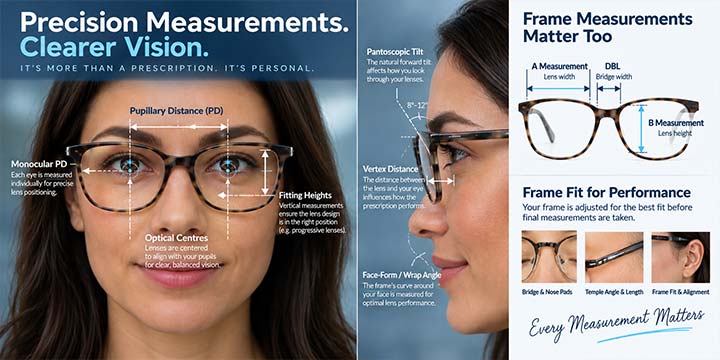
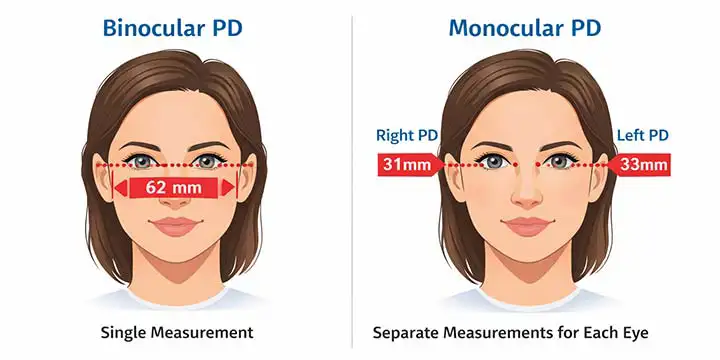
Pupillary distance, or PD, measures the horizontal position of the pupils. Rather than relying solely on one total binocular PD, our Edmonton opticians can measure monocular PDs—the distance from the centre of the bridge of the nose to each pupil independently.Why does that matter? Faces are not always perfectly symmetrical. One eye may sit slightly farther from the centre of the nose than the other. Monocular measurements allow the optical centre or reference point of each lens to be positioned specifically for each eye. Accurate PD measurements help your eyes look through the intended portions of your lenses and can be particularly important with stronger prescriptions and more sophisticated lens designs.
Optical Centres
Every prescription lens has an optical centre or prescribed reference point through which the lens is intended to deliver its correction. Where that point is positioned within your frame depends on more than the frame's dimensions. The location of your eyes within the frame must also be considered.If the optical centres are not positioned appropriately relative to your pupils, looking through the lenses can introduce unwanted prismatic effects and potentially contribute to symptoms such as visual discomfort, eyestrain or difficulty adapting to new glasses. Precision centration helps ensure the prescription your optometrist prescribed is delivered where your eyes actually need it.
Fitting and Segmentation Heights
Horizontal measurements are only half the equation. Fitting height determines the vertical position of the lens design relative to your eye. This becomes particularly important with:- Progressive lenses
- Bifocals and trifocals
- Anti-fatigue lenses
- Office and computer lenses
- Occupational lens designs
- Other digitally surfaced or personalized lenses
Vertex Distance
Vertex distance is the distance between the back surface of the eyeglass lens and the front of the eye. This distance is influenced by the frame, bridge fit, nose pads and how the temples sit around the ears.For many prescriptions, small variations may have limited practical impact. With higher prescriptions or advanced personalized lens designs, however, vertex distance becomes increasingly important. Modern lens designs can use the actual wearing position of the frame as part of the lens calculations. That means the way your glasses sit on your face can become part of the optical design itself.
Pantoscopic Tilt
Look at a properly fitted pair of glasses from the side and you'll often notice that the lenses aren't perfectly vertical. This angle is known as pantoscopic tilt.The appropriate tilt depends on the frame, facial anatomy and lens design. It affects the angle at which your eyes look through the lenses and can influence the performance of personalized and digitally designed lenses. Rather than assuming every frame sits at the same angle, an optician can evaluate how your chosen frame actually rests on your face.
Face-Form or Wrap Angle
Frames can also curve around the face horizontally. This is often referred to as face-form angle, frame wrap or wrap angle.Some frames are relatively flat, while sport and fashion frames may wrap considerably around the face. As wrap increases, the relationship between the lens and the wearer's line of sight changes. For appropriate prescriptions and lens designs, these parameters can be incorporated into lens calculations to optimize the finished eyewear.
Frame Dimensions Matter Too
The dimensions of the frame itself influence how your lenses are designed and manufactured. Important measurements can include:- A measurement: the horizontal lens opening.
- B measurement: the vertical lens opening.
- DBL (distance between lenses): the distance between the two lens openings at the bridge.
- Effective diameter: a measurement used by the laboratory to determine the lens blank size required to cut the lens for a particular frame shape.
Frame Fit Comes Before Precision Measurements
Accurate measurements should be taken with the frame sitting where it will actually be worn. Before final measurements are taken, an optician may need to adjust:- Bridge or nose-pad position
- Frame width and alignment
- Temple angle
- Temple length and bend
- Pantoscopic tilt
- Face-form or frame wrap
- Frame height on the face
- Distance between the lenses and eyes
- Overall frame level and symmetry
Fit first. Measure second. Verify again when the finished glasses arrive.
Digital Measurements Add Another Level of Precision
Modern optical technology allows many of these measurements to be captured digitally. Depending on the lens and frame, digital measurement systems can help determine parameters such as monocular PD, fitting heights and various position-of-wear measurements.These measurements can then be used with modern digitally surfaced or free-form lens designs to customize how the lenses are calculated for the individual wearer and frame. Digital systems also provide an opportunity to document measurements and reduce some of the variability associated with traditional measurement techniques. But technology isn't a substitute for an experienced optician.
Why We Still Use Manual Measurements
There is tremendous value in traditional optical measurement tools. A PD ruler, pupilometer, lensometer, frame ruler and the trained eye and hands of an optician remain important parts of dispensing prescription eyewear.Manual measurements can verify digital measurements, identify unusual results and provide an independent check before lenses are ordered. For this reason, the best approach isn't necessarily digital versus manual. It's digital plus manual. Technology can provide precision and sophisticated measurements. An experienced optician provides interpretation, verification and an understanding of how the frame, lenses and person interact.
Frame Selection Can Affect Lens Performance
Not every frame is equally well suited to every prescription. Your optician may consider factors such as:- Prescription strength
- Lens thickness
- Amount of astigmatism
- Progressive or multifocal requirements
- Required fitting height
- Frame size and shape
- Bridge fit
- Eye position within the frame
- Lens material
- Frame wrap
- Lifestyle and visual demands
For a progressive wearer, sufficient vertical frame depth may be needed to comfortably accommodate the desired progressive lens design. For office eyewear, the frame and measurements must support a lens specifically designed around the wearer's computer and working distances. Good optical dispensing therefore begins before the lenses are ever ordered.
The Measurements Don't End When Your Glasses Arrive
When finished prescription glasses return from the laboratory, there is another critical step: verification and final fitting. The eyewear should be checked to ensure the finished lenses correspond with the ordered prescription and measurements. The frame is then fitted to the wearer.Your optician may adjust the nose pads, bridge, temples, frame level, tilt and wrap so the glasses sit securely and comfortably while maintaining the intended lens position. The goal isn't simply to make the glasses "feel comfortable." The goal is to achieve comfort, stability and optical alignment at the same time.
Small Measurements Can Make a Big Difference
Eyeglass lenses are precision optical devices. A difference of a few millimetres may sound insignificant when discussing something the size of a pair of glasses, but those millimetres determine where your eyes intersect a carefully designed optical surface. And today's lenses can be extraordinarily sophisticated.Progressive lenses may incorporate multiple viewing zones. Office lenses can be optimized for intermediate and near working distances. Digital free-form lenses can account for frame position and individual wearing parameters. The more sophisticated the lens, the more important accurate measurements and fitting become.
Prescription Glasses Should Be Made for the Person Wearing Them
There is a difference between putting the correct prescription into a frame and creating eyewear that is properly fitted, measured and verified for the person who will wear it.At Eye-deology Vision Care, our Edmonton optical combines professional frame fitting, precision digital measurements, traditional manual verification and experienced optical dispensing to help translate your optometrist's prescription into eyewear designed to provide clear, comfortable vision. Our Edmonton opticians consider not only your prescription, but also your pupils, facial anatomy, frame choice, lens design and the position in which your glasses will actually be worn.
Because great prescription eyewear isn't just about choosing the right lenses or the right frame. It's about making sure the right lenses are positioned in the right frame, in the right place, in front of your eyes.
Schedule An AppointmentFYEyes Blog Posts
Pupillary Distance (PD) and Why It Matters for Glasses
Pupillary distance (PD) is the measurement, in millimetres, between the centres of your pupils. An accurate PD measurement is need for crafting prescription glasses.

Do I Need New Glasses? Signs It May Be Time to Update Your Eyewear
Wondering if you need new glasses? Learn what some of the sign are that you need new eyewear.

Why Your Everyday Glasses May Not Be the Best Glasses for Computer Work
Discover how computer and office lenses can improve screen comfort and intermediate vision.

Adapting to Progressive Glasses: What To Expect & How to Adjust
Progressive lenses require adaptation. Here's what to expect.

Children's Glasses
Invest in your child's health and future with eyeglasses professionally custom-crafted to their individual needs and active lifestyles.

Women's Glasses
Upgrade your vision and your look with new women's eyeglass styles. Find your new vision and look at our Edmonton optical.

Men's Glasses
See your best and be your best with eyeglasses designed specifically for your work environment and lifestyle preferences.