Pupillary Distance (PD) and Why It Matters for Glasses
13-03-2026
When ordering prescription glasses, one measurement plays a critical role in how clearly and comfortably you see: pupillary distance (PD). Many people assume PD is a number included in a prescription, but in reality it is a precision measurement used when crafting glasses. An accurate PD measurement helps ensure that the optical centre of your lenses aligns perfectly with your eyes, allowing your glasses to deliver the vision correction your prescription is designed to provide.
What Is Pupillary Distance?
The Distance Between Pupil Centres
Pupillary distance (PD) is the measurement, in millimetres, between the centres of your pupils. This measurement indicates to the lab optician where to position the optical centre of each lens so that light passes through the correct part of the lens when you look straight ahead. When the optical centre aligns with your pupils:- Vision is clearer
- Eye strain is reduced
- Lenses perform as intended
- Glasses feel more comfortable to wear
How Pupillary Distance Is Measured
Precision Instrumentation
Traditionally, PD was measured with a pupil ruler. Today, many modern optical clinics use digital measurement systems that can capture highly accurate facial measurements. At a professional optical dispensary, PD is typically measured using:- A digital optical measuring device
- A pupilometer
- A calibrated optical ruler
Why Pupillary Distance Should Be Measured for Each Eye
Monocular PDs are Best
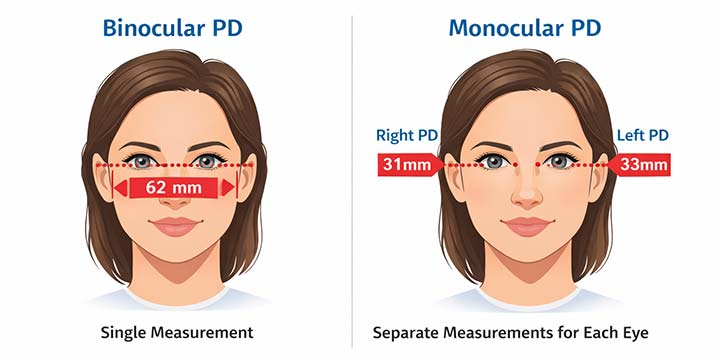
Many prescriptions list PD as a single number, known as a binocular PD. For example, a PD of 62 mm. However, most people are not perfectly symmetrical. One eye is often slightly closer to the nose than the other. Because of this, opticians frequently measure monocular PD, which separates the measurement into two values:- Right eye PD
- Left eye PD
- Right PD: 31 mm
- Left PD: 33 mm
Why PD Is Different for Distance and Near Vision
Eyes Move Inward To See Near Objects
Pupillary distance is not always the same for all types of lenses. When we focus on near objects, our eyes naturally converge inward. This means the distance between the pupils becomes slightly smaller. Because of this, PD measurements differ depending on the intended use of the glasses:- Used for driving and general vision correction
- Used for reading glasses or computer lenses
Why Measuring PD Yourself Is Very Difficult
Small Errors = Big Problems
Online guides often suggest measuring PD at home using a mirror or smartphone app. Unfortunately, these methods are rarely accurate enough for prescription eyewear. Self-measurement is difficult because:- Your eyes naturally move when trying to measure them
- Holding a ruler precisely aligned is challenging
- Small errors of even 1–2 mm can affect lens performance
- Monocular PD cannot be reliably measured alone
Why Pupillary Distance Should Be Measured With the Frame On
PD Changes With Frame Size/Fit
One of the most overlooked aspects of PD measurement is that the frame itself affects where the lenses sit relative to your eyes. Different frames have different:- Bridge widths
- Frame shapes
- Lens sizes
- How they sit on the nose
Why PD Alone Is Not Enough
Optical Centre Requires 2 Measurements
Many people assume that once they know their PD, they can order glasses anywhere. In reality, PD alone is only part of the optical measurements needed to make high-quality glasses. Another important measurement is the vertical pupil height, which determines where the optical centre sits vertically in the frame. Without this measurement, the lenses may not align correctly when the glasses are worn. This is especially important for:- Progressive lenses
- Bifocals
- High prescriptions
- Large frames
Why Pupillary Distance Is Not Included An Eye Exam
PD Is Measured Only To Craft Eyewear
Many patients are surprised that PD is not always listed on their prescription after an eye exam. The reason is simple: PD is not actually part of the medical eye exam. An eye exam focuses on evaluating:- Eye health
- Vision clarity
- Prescription strength
- Detection of eye disease
FYEyes Blog Posts

Myopia - Symptoms, Causes and Treatment
A refractive error that affects the eye's ability to focus on distant objects clearly.

Hyperopia - Symptoms, Causes and Treatment
A refractive error that affects the eye's ability to focus on near objects.

Astigmatism - Symptoms, Causes and Treatment
A refractive error caused by a cornea or lens of the eye that is not perfectly symmetrical.

Everything You Need to Know About Children’s Glasses
Looking for glasses for your child? Here's everything you need to know.

Children's Glasses
Invest in your child's health and future with eyeglasses professionally custom-crafted to their individual needs and active lifestyles.

Women's Glasses
Upgrade your vision and your look with new women's eyeglass styles. Find your new vision and look at our Edmonton optical.

Men's Glasses
See your best and be your best with eyeglasses designed specifically for your work environment and lifestyle preferences.